Last updated: April 2026 · AnomixLabs Technical Team
Software development is a marathon, not a sprint. Sustaining motivation is a skill as critical as technical proficiency. Even the most talented developer will burn out without the right systems.
Why Do Developers Lose Motivation?
According to JetBrains' 2024 Developer Ecosystem survey, 45% of developers reported experiencing burnout symptoms last year. Stack Overflow's 2024 data reveals that 58% of experienced developers admit to experiencing imposter syndrome.

Key motivation killers:
- Imposter Syndrome: Feeling like you're not good enough and that others will 'figure you out'.
- Burnout: The accumulation of constant overload, lack of recognition, and a sense of meaninglessness.
- Tutorial Hell: Constantly watching courses without ever building real projects — feeling like you're progressing but actually stagnating.
- Cognitive Overload: Thinking in too many contexts simultaneously — code, meetings, Slack, PR reviews, bug fixes...
Technique 1: Deep Work with Pomodoro
Developed by Francesco Cirillo in the 1980s, the Pomodoro Technique breaks down focus into intervals. Neuroscience research suggests the human brain's capacity for intense focus is limited to 25-50 minutes:
- 25 minutes of focused work (1 pomodoro)
- 5-minute short break
- 15-30 minute long break after 4 pomodoros
Tools: Toggl Track (time tracking + pomodoro), Forest (gamifies putting your phone away), Flow (minimal timer for macOS). Confining social media to break times eliminates distractions overnight.
Technique 2: Entering the Flow State
The 'flow state,' as defined by Mihaly Csikszentmihalyi, is a state of deep concentration where the perception of time disappears. According to Cal Newport's book *Deep Work*:
- Silence your phone and place it out of sight (even in the same room can be distracting — Brown University research)
- Set a consistent 'deep work' block (e.g., 09:00-12:00 daily)
- Balance task difficulty with your skill level
- Use noise-canceling headphones in open-plan offices
Technique 3: Maker Schedule vs. Manager Schedule
Paul Graham's 2009 essay 'Maker's Schedule, Manager's Schedule' remains relevant. The ideal workday for developers (makers) involves a long focus block in the morning, followed by meetings/code reviews in the afternoon. Scheduling meetings between 09:00-11:00 can cripple developer productivity. If possible, consolidate your meetings into the afternoon.
Technique 4: The Dopamine Loop with Small Wins
The brain loves a sense of completion. Breaking down large goals into smaller pieces creates a continuous feeling of accomplishment:
- HackerRank / Codewars: 1 Easy problem per day — ten minutes, strong sense of achievement
- Daily commits to GitHub: The contribution graph provides visual motivation
- Check off completed tasks: Ticking items off a to-do list releases dopamine
- Mini-projects: Writing a small script on the weekend can break through blocks in larger projects
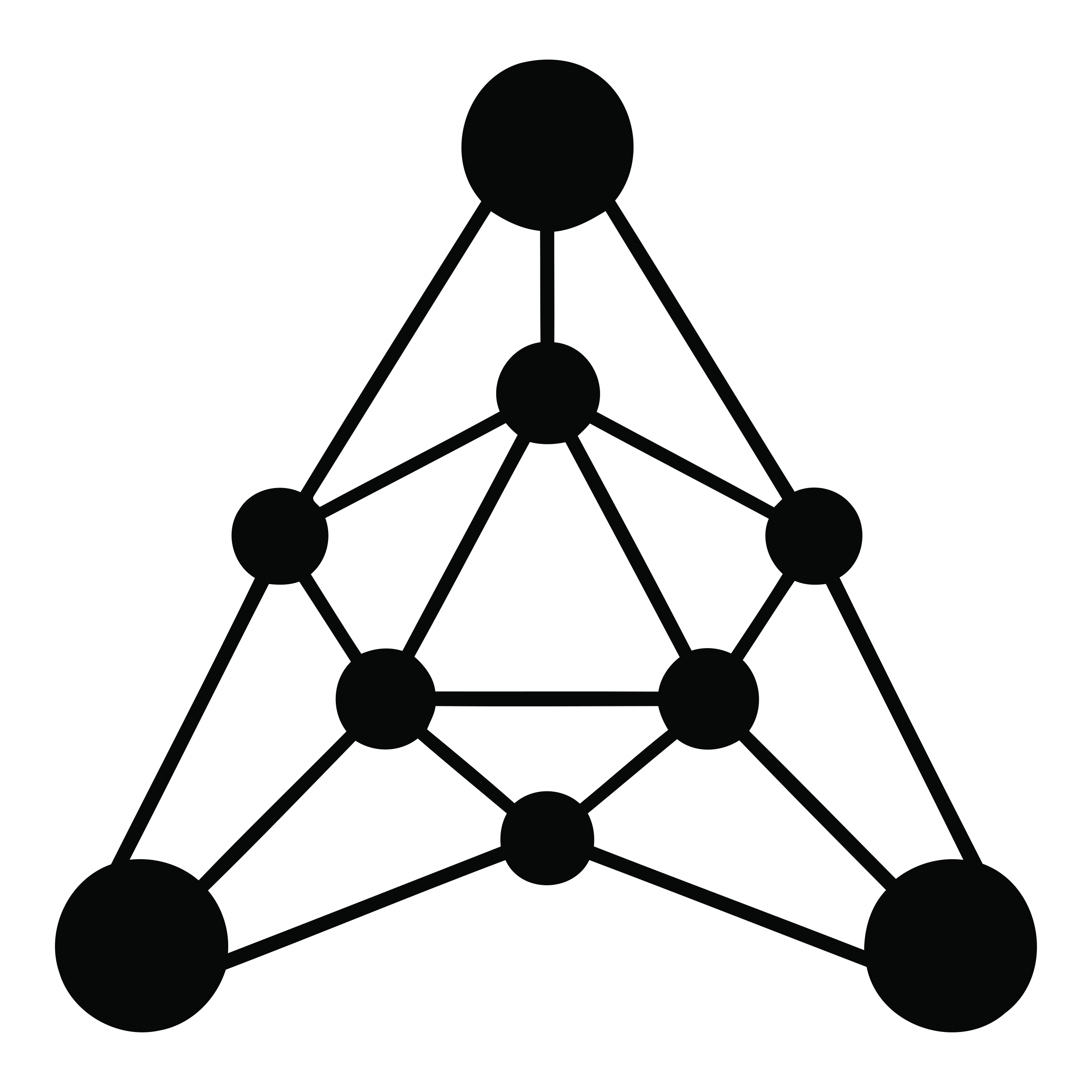
Technique 5: The Goal Pyramid
Create a hierarchy: Daily → Weekly → Monthly → Yearly. Each morning, write down 3 things: 1 critical task, 2 important tasks, 1 learning goal. This clarity prevents the 'what should I do?' paralysis and reduces morning decision fatigue.
Technique 6: The Brain Benefits of Sleep and Exercise
According to Matthew Walker's research in *Why We Sleep*, 7-8 hours of sleep increases problem-solving capacity by 30%. Code written late at night has a dramatically higher error rate. Regular exercise (3x30 min/week) boosts learning capacity by increasing BDNF (Brain-Derived Neurotrophic Factor) production.
Ergonomics are also critical: monitor at eye level, keyboard with arms at 90 degrees, chair supporting the hip bones. Most developers maintain a positive routine of standing up once an hour.
Technique 7: Automate Tedious Tasks with AI Tools
By 2025, a significant portion of demotivation sources will be repetitive, mechanical tasks:
- Boilerplate code: In seconds with Claude Code, Cursor, or GitHub Copilot
- Writing tests: 'Write pytest tests for this function' — ready in minutes
- Debugging: Paste the stack trace, get instant analysis
- Documentation: Automatic docstring generation from code blocks
- Code review: 'Review this PR, find security vulnerabilities and performance issues'
Burnout Symptoms and Exit Strategy
Early warning signs:
- Reluctance to start work in the morning
- Exaggerating minor mistakes into major disappointments
- Loss of enjoyment in hobbies
- Social isolation, reduced communication
- Constant fatigue, changes in sleep patterns
Ignoring burnout leads to months of lost productivity. The exit strategy: take a 1-2 week complete break, engage in non-technical activities, then return with a small, enjoyable project. Burnout is not a weakness of character but a problem of accumulation.
The Importance of Community Involvement
Working in isolation erodes motivation. Solutions:
- Discord servers: Communities like Python Turkey, Django TR
- Meetups and conferences: PyCon TR, local software meetups
- Build in public: Share what you're building on Twitter/X or LinkedIn
- Open source contributions: Getting your first PR merged is incredibly motivating
Summary
Motivation is not a feeling but a system to be built: focus with Pomodoro, deep work with a maker schedule, dopamine through small wins, the goal pyramid, sleep/exercise discipline, automation with AI, and community support. Burnout must be recognized early — stop before you're depleted.
Frequently Questions
How do you overcome imposter syndrome? expand_more
Do I have to code every single day? expand_more
How do I escape tutorial hell? expand_more
How do you maintain motivation when working remotely? expand_more
I'm experiencing a motivation dip during a seniority transition — is that normal? expand_more
Is it better to work long hours or work efficiently? expand_more
Is there a downside to taking a career break? expand_more
Ali Kasımoğlu
Full-stack Developer & Founder of AnomixLabs
A software developer specializing in the Python and Django ecosystem. Focuses on modern web architectures, AI integrations, and minimalist user experiences. Under the AnomixLabs umbrella, he aims to transform complex problems into lean and effective digital solutions.